
Turntable Robot Cell Palletizing System
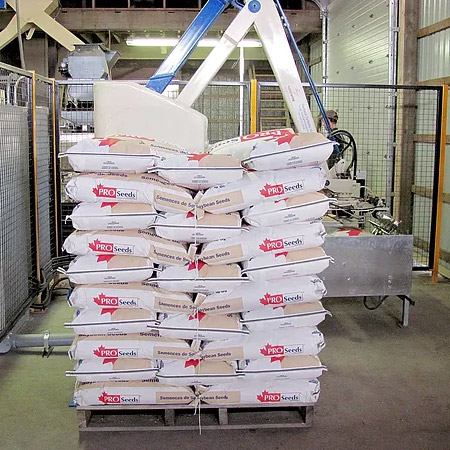
A turntable robot cell is a simple, easy-to-run robotic palletizer, and it is narrower than a dual cell — which makes it the one to choose when floor space is tight. The robot picks filled bags off the infeed conveyor and stacks them onto an empty pallet sitting on a two-position turntable. When the pallet is full, the turntable rotates the empty pallet into the stacking position and the robot keeps working while your forklift operator pulls the finished load from the other side. That exchange takes the same 25 seconds every time, so your output is predictable rather than dependent on how fast a forklift gets there. Typical output is 8 to 12 bags per minute, and the narrow footprint means this layout fits where a wider cell will not.
See the Turntable Robot Cell in Action
Watch the Fuji robot pick filled bags off the infeed and stack them onto the pallet in its programmed pattern. When the pallet is full, the two-position turntable rotates — indexing a fresh pallet into place so the robot keeps stacking while the finished load is removed from the other side.
What Is a Turntable Robot Cell?
A turntable robot cell is one robot, one infeed and a two-position turntable. The turntable is what keeps the cell moving. Instead of one pallet on the floor — where a full load means halting the robot and letting a forklift inside the guarding — the turntable carries two pallets. The robot stacks one while the other is being emptied and replaced.
The robot does pause during the exchange — the turntable takes approximately 25 seconds to swap pallets — but that is the whole stoppage. The operator and the forklift stay outside the guarding the entire time, and the robot is back stacking before the full load has left the cell.
Sequence of Operations
Here is exactly what happens, from the bagging line to the finished pallet:
- Bag discharge. The filled and sealed bag exits the bagging conveyor.
- Bag kicker. A kicker lays the bag down on its back, bottom first, so every bag arrives in the same orientation.
- Flatten and square. The bag runs through a bag flattener and bag squaring guides, which settle the product and give the robot a consistent, repeatable shape to pick.
- Pickup station. The bag travels to the robot pickup conveyor and trips the “bag in place” sensor.
- Pick. The robot is already waiting at the pickup with the end effector open. It closes on the bag and lifts.
- Place. The robot places the bag on the pallet on the turntable, in the pattern programmed for that product.
- Index. When the pallet is full, the robot pauses and the turntable rotates the next empty pallet into the stacking position — approximately 25 seconds — then the robot carries on stacking.
- Removal. While the robot is stacking, the forklift operator removes the full pallet from the other side of the turntable and sets an empty one in its place.
The turntable exchange takes approximately 25 seconds, and that is the only stoppage in the cycle. Compare that to a fixed single pallet position, where a full load means shutting the cell down, locking out, and letting a forklift inside the guarding.
Why the Turntable Is the Part That Matters
With the turntable, the robot stops once — for the roughly 25 second exchange — and everything else happens outside the fence while it is already stacking again. You get:
- A 25 second pallet change — instead of minutes of downtime
- Nobody inside the cell — the forklift works from the load/unload side, outside the guarding and light curtains
- Predictable output — the line runs at machine pace instead of forklift pace
Turntable Robot Cell Specifications
| Cell type | Single robot palletizing cell with a two-position turntable |
| Typical throughput | 8 to 12 bags per minute |
| Robot | Fuji ACE four-axis palletizing robot — model selected to suit speed and reach |
| Pallet positions | Two, carried on the turntable |
| Turntable exchange time | Approximately 25 seconds — the robot pauses for the exchange only |
| Pallet change | Forklift removes the full pallet from outside the guarding while the robot stacks the second |
| Infeed | Bag kicker, bag flattener, bag squaring guides, pickup conveyor with bag-in-place sensor |
| End effector | Pneumatic cylinders clamp the side and top of the bag during palletizing |
| Products | Open mouth and valve bags — paper, woven polypropylene, poly |
| Pallet sizes | Flexible; multiple pallet sizes and stack patterns stored in the controls |
| Safety | Perimeter guarding, light curtains at the load/unload opening, interlocked access |
| Footprint | Compact — one robot, one turntable, no pallet conveyor |
Throughput depends on bag size, weight and stack pattern. Send us your bag spec and pallet pattern and we will give you a real number, not a brochure number.
The Fuji ACE Robot at the Centre of the Cell
HS Automation builds these cells around Fuji ACE palletizing robots. Fuji builds four-axis robots specifically for palletizing — not general-purpose arms adapted to it — and the Fuji software makes the robots easy to operate and service for years to come. Two models cover almost every turntable cell:
| Fuji ACE model | Best suited to |
| EC-102 | 8–12 bags per minute |
| EC-171 | 12–18 bags per minute |
What Comes With the System
- Bag kicker — lays the bag down bottom first, in one consistent orientation
- Bag flattener — settles the product so the stack is square and stable
- Bag squaring guides — presents the same bag shape to the robot every time
- Pickup conveyor — with the bag-in-place sensor that triggers the pick
- Fuji ACE robot and end effector — tooled to your bag or case
- Two-position turntable — the part that keeps the cell running
- Guarding, light curtains and interlocks — engineered to the layout of your plant
- Controls and stack patterns — recipes stored per product so a changeover is a selection, not a reprogram
Why a Turntable Cell Is the Right Place to Start
Most plants automating palletizing for the first time should start here. The reasons are practical:
- Low cost of entry — a simple and cost-effective robotic cell
- Smallest footprint — one robot and a turntable, no long pallet conveyor runs to find room for
- Fewer failure points — a simpler cell has less to go wrong and less to maintain
- Flexible — handles multiple pallet sizes and stack patterns without mechanical changeover
- Easy to run — an operator swaps the pallets and keeps the production line running
It also takes the worst job in the plant away from a person. Hand-stacking 50 lb bags all shift is where back injuries and turnover come from, and it is the first thing a new hire quits over.
Common Applications
- Agriculture — seed, grain, animal feed, fertilizer
- Food processing — flour, sugar, rice, pulses, powder blends
- Pet food — multiwall paper and woven polypropylene bags
- Chemicals and minerals — powders, granules, plastic resins
- Building products — sand, aggregate, dry mixes
If you are filling bags on one line and stacking them by hand at the end of it, a turntable robot cell is almost certainly the machine you are looking for. See our open mouth bag automation.
When You Need More Than a Turntable Cell
A turntable cell handles one infeed line. If you are running two bagging lines into one palletizing area, or you need higher throughput than 12 bags per minute, look at a dual cell — one robot serving two infeeds and two stacking positions.
For fully automated pallet handling including a pallet and slip-sheet dispenser, pallet conveyors and so on, look at an auto cell.
And if your layout does not fit any of the three, we build custom cells.
Installation, Training and Service from HS Automation
A palletizing robot is not a machine you buy off a shelf. The cell has to fit your building, your bag, your pallet pattern and the way your people work.
- Layout and engineering — we lay the cell into your floor plan before anything is built
- Installation and commissioning — we set it, wire it, program your stack patterns and run your product before we leave
- Operator training — your people learn to run it, change patterns and clear faults themselves
- Service and support — our technicians support the robot and the cell around it, not just one or the other
- Parts — we stock what wears and we know what fails. See Parts & Services.
We are a family-run company with over 100 combined years in bag filling, bag closing and grain and seed processing. When you call, you reach someone who has stood beside the machine. Contact us today to talk through your line.
Frequently Asked Questions
What is a turntable robot cell?
It is a robotic palletizing cell with one robot and a two-position turntable. The robot stacks bags onto one pallet while the second pallet position is accessible to a forklift. When a pallet fills, the turntable rotates the empty pallet into the stacking position — about 25 seconds — and the robot carries on stacking while the forklift removes the full load from the other side.
How fast is a turntable robot cell?
A typical turntable robot cell runs 8 to 12 bags per minute. Actual throughput depends on bag size, bag weight and the stack pattern.
How does the turntable work?
The turntable carries two pallets. When the pallet being stacked is full, the turntable indexes the empty pallet into the robot’s stacking position. That exchange takes approximately 25 seconds, and it is the only time the robot stops. The forklift operator then removes the full pallet from the opposite side while the robot continues stacking the fresh one.
Does the robot stop when a pallet is changed?
Only for the exchange itself. The turntable takes approximately 25 seconds to swap the full pallet out of the stacking position and the empty one in. After that the robot resumes stacking while the forklift removes the full load from outside the guarding — so nobody enters the cell and the robot is not waiting on a forklift.
What happens to the bag before the robot picks it up?
The filled and sealed bag exits the bagging conveyor and a bag kicker lays it down on its back, bottom first. It then runs through a bag flattener and bag squaring guides so every bag arrives at the pickup conveyor in the same shape and orientation. A bag-in-place sensor on the pickup conveyor tells the robot to close its end effector and pick.
Which robot is used in a turntable robot cell?
HS Automation builds these cells around Fuji ACE four-axis palletizing robots. The EC-102 suits tight spaces and low to medium output; the EC-171 has the largest working envelope with the smallest rotation radius for layouts needing more reach; the EC-202 is the fastest and strongest for high output or heavy products.
Can one system handle different pallet sizes?
Yes. Multiple pallet sizes and stack patterns are stored in the controls, so changing product or pallet is a selection on the panel rather than a mechanical changeover. We can handle CHEP, EURO, 40″x48″ and other larger customer pallets as well.
How much space does a turntable robot cell need?
A turntable robot cell has the smallest footprint of any of our robotic palletizing configurations — one robot and one turntable, with no pallet conveyor runs. Send us your floor plan and we will lay the cell into it before you commit to anything.
When should I choose a dual cell or auto cell instead?
Choose a dual cell when you are feeding two bagging lines into one palletizing area or need more than about 12 bags per minute. Choose an auto cell when you want pallets fed in and out automatically with no forklift in the palletizing loop.
Does HS Automation install and service the system?
Yes. We engineer the cell into your layout, install and commission it, program your stack patterns, train your operators, and support the robot and the equipment around it afterwards.

Contact Us
Phone
519-245-2310