
Dual Cell Robot Palletizer System
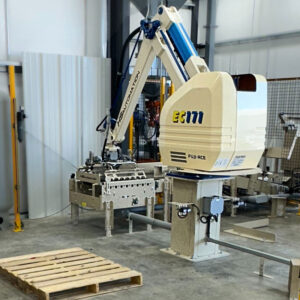
Dual cell palletizers are a very popular layout for manufacturing automation. It allows for continuous stacking and keeps the cell very simple to operate.
A dual cell palletizer gives one robot two floor-level stacking stations instead of one. When the pallet at station #1 is full, the robot turns to station #2 and keeps working. Nothing indexes, nothing waits, and the operator is not standing at the cell watching a pallet change. Depending on the robot, a dual cell stacks between 8 and 18 bags, cases, pails or bundles per minute.
It is the middle option in our palletizing line-up. A turntable robot cell is narrower footprint but pauses roughly 25 seconds for each pallet exchange. An auto cell handles pallets automatically and keeps forklifts out of the cell entirely, at a higher price and a larger footprint. The dual cell sits between them: continuous stacking, a small footprint, and a forklift that only ever enters the station the robot has already left.
See a Dual Cell Palletizer in Operation
Watch a dual cell robot palletizer switch stations — the robot moves to the second pallet while a forklift clears the first, with no pause in stacking.
How a Dual Cell Palletizer Works
Our safety system allows continuous operation: once the pallet is full at station #1 the robot automatically switches to station #2. Our safety system allows the forklift to enter stacking station #1 and remove the full pallet while the robot continues to stack station #2.
That is the whole idea. The two stations are zoned separately. While the robot is working station #2, station #1 is a safe area a forklift or pallet jack can enter, take the finished load out, drop an empty pallet and leave. The station is reset and waiting long before the robot needs it again. When station #2 fills, the robot switches back and the cycle repeats on the other side.
There is no pallet conveyor, no turntable and no pallet dispenser. That is what keeps a dual cell simple to operate and less expensive than an auto cell: the only moving parts are the robot, the infeed and the end-of-arm tooling. Fewer components means fewer things to maintain and a shorter list of things an operator has to learn.
Sequence of Operations
A typical bag line through a dual cell runs as follows.
- The filled and closed bag arrives on the discharge conveyor and is transferred by a kicker onto the palletizer infeed.
- A bag flattener presses the bag down to an even, stable profile so the stack builds square and stays square through wrapping and transport.
- Squaring guides align the bag on the conveyor so the robot picks from a known position every time.
- The bag advances to the pickup conveyor. A bag-in-place sensor confirms the bag is present and correctly positioned before the robot is released to pick.
- The robot picks the bag with the end-of-arm tooling specified for your product — clamp, fork or vacuum.
- The robot places the bag on the active stacking station according to the pallet pattern selected at the HMI, building layer by layer.
- When the pattern is complete, the robot automatically switches to the second stacking station and continues without stopping.
- The safety system releases the finished station. A forklift or pallet jack enters, removes the full pallet and sets an empty pallet in position.
- The station is reset and waits. When the second pallet is complete, the robot switches back and the cycle repeats.
Dual Cell vs Turntable Robot Cell vs Auto Cell
The three layouts differ in one thing: what happens to the pallet. Everything else — the robot, the tooling, the infeed — can be identical.
| Turntable Robot Cell | Dual Cell | Auto Cell | |
| Stacking positions | Two, on one turntable | Two, on the floor | One on a conveyor |
| Pallet change | Turntable indexes the full pallet out | Robot switches to the other station | Pallets fed and removed automatically |
| Does the robot pause? | Yes — approx. 25 seconds per exchange | No — it moves to the other station | Robot pauses during pallet change, but catches back up |
| Forklift | Stays outside the guarding | Enters only the station the robot has left | No forklift inside the cell |
| Footprint | Small | Small — wider than a turntable cell | Largest |
| Throughput | 8–12 bags/min | 8–18 bags/min | 15–22 bags/min |
| Operator involvement | Keep your forklift busy | Keep your forklift busy | Built-in pallet accumulation |
| Relative cost | Middle | Lowest | Highest |
| Best for | Tight floor space, low to medium output | Medium output where a forklift is already on the floor | High output, lights-out shifts, no forklift traffic |
Palletizing Robots We Use
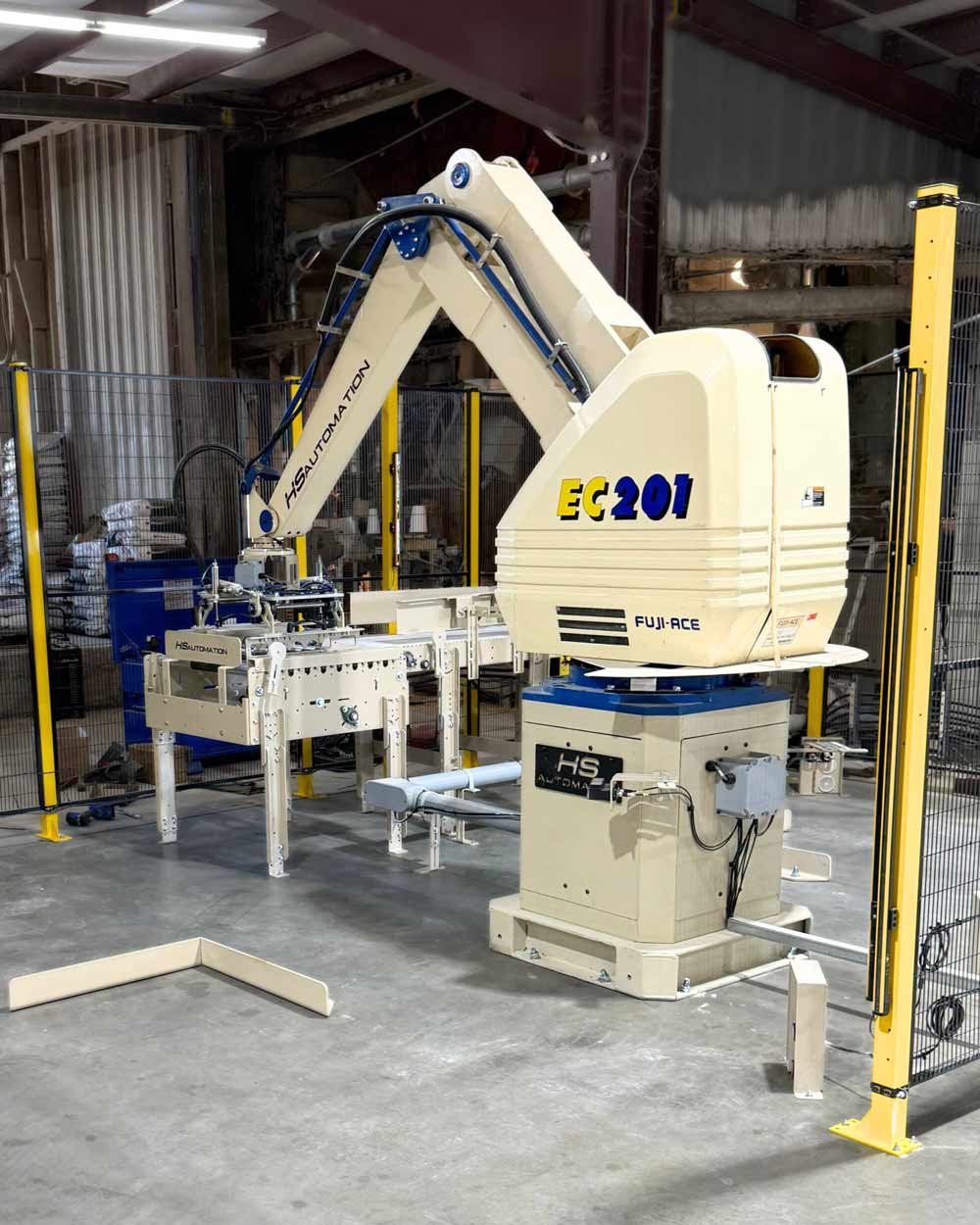
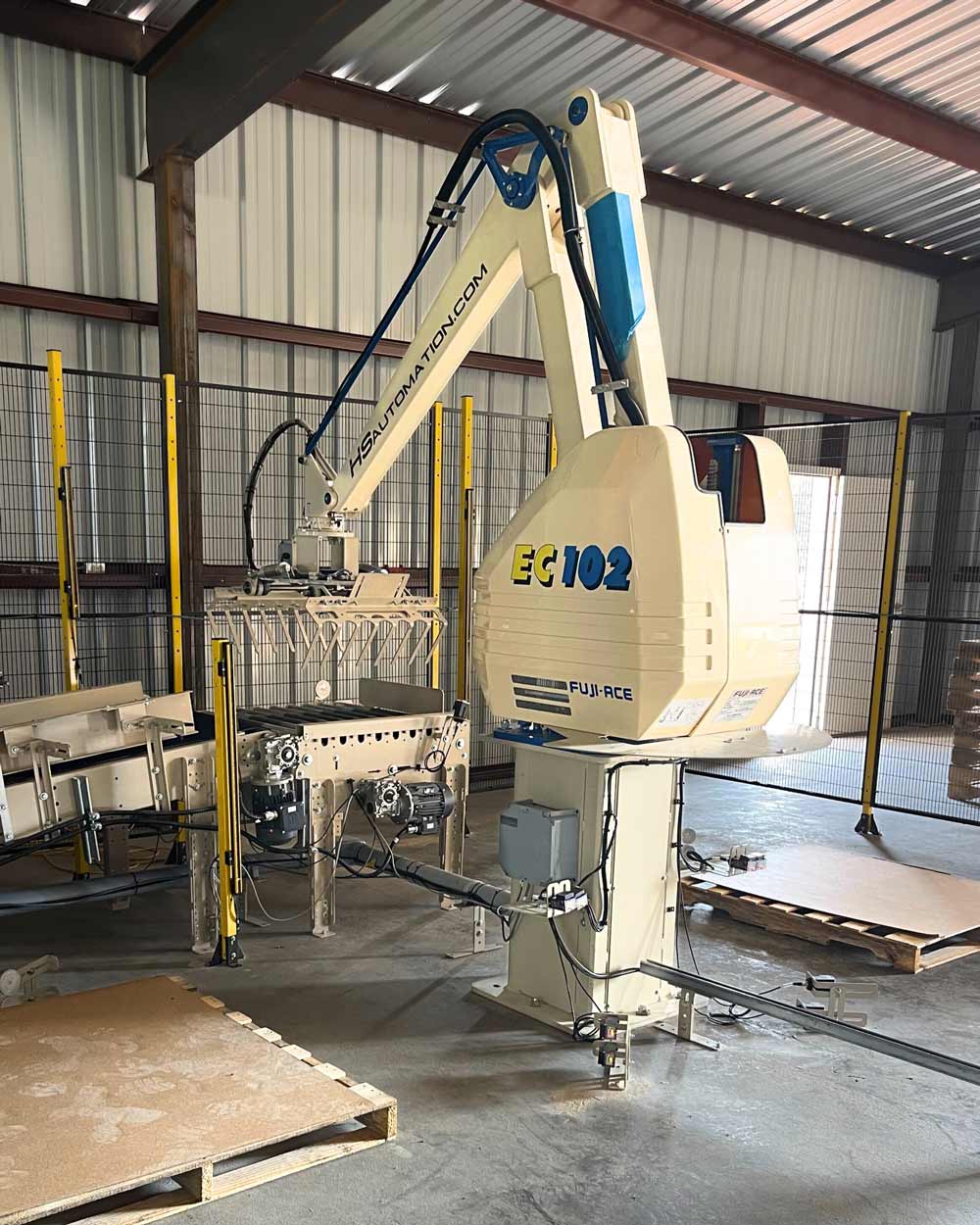
HS Automation builds dual cells around Fuji ACE palletizing robots. Two models suit this layout. They have similar reach and weight capacity, so the choice comes down to the speed you need.
| Model | Fuji’s description | Typical dual cell rate |
| ACE EC-102 | Fuji’s most efficient robot, aimed at product lines where space is tight or with low-to-medium output speeds. | 8 to 12 bags per minute |
| ACE EC-171 | The largest working envelope of the series, made for operations with medium output and layouts requiring a farther reach. | 12 to 18 bags per minute |
If your line runs faster than 18 per minute or your product is heavy enough to need Fuji’s largest robot, the ACE EC-202 is the next step and is normally paired with an auto cell rather than a dual cell. We will tell you which combination fits your rate rather than selling you more robot than the line can feed. For unusual layouts we also build custom palletizing cells.
What a Dual Cell Palletizer Handles
The end-of-arm tooling is built for the product, so one cell layout covers a wide range of packaging.
- Open mouth bags — sewn, glued or heat sealed, from bag filling and open mouth bag automation lines
- Valve bags, including cement, mineral and powder products
- Pinch bags and fold-over glued paper bags
- Cases and cartons
- Pails and rigid containers
- Bales, bundles and compressed product
Pallet patterns are stored in the robot controller and selected from the HMI, so a product changeover is a menu selection, not a mechanical adjustment. New patterns are built and adjusted by us or by a trained operator. See our end-of-arm tooling and accessories.
Safety
The dual cell only works because the two stations are safeguarded independently. The cell is fenced, the infeed opening is protected, and each stacking station has its own zone. A station is only released to a forklift once the robot has left it and the controller confirms the robot is working the opposite side. If someone enters an active zone, the robot stops.
This is what lets a forklift work at the same cell as a running robot without a lockout and without an operator waiting for a cycle to end. Guarding, light curtains, interlocks and zone logic are specified for each layout, because floor traffic is different in every plant.
Footprint and Installation
A dual cell palletizer occupies roughly 20 feet by 17 feet — about 340 square feet of floor, including the robot, both pallet positions and the guarding envelope. That is a small enough area to fit at the end of an existing line in most plants, and considerably less than a fully automatic cell needs.
The footprint stays compact because there is no pallet conveyor and no pallet dispenser. Nothing has to be routed through the building to feed empty pallets in or carry full ones out — a forklift or pallet jack already working that part of the floor does it. The cell drops into the line where the line already ends.
Support Across North America
HS Automation builds, installs and services palletizing cells from Strathroy, Ontario, and supports customers across Canada and the United States. Spare parts and service, tooling, pattern changes and preventive maintenance come from the same people who built the cell, so there is no handoff between the builder and the service company.
Request a quote on a dual cell palletizer, or call 519-245-2310 to talk through your line rate, product and floor space.
Frequently Asked Questions
What is a dual cell palletizer?
A dual cell palletizer is a robotic palletizing cell with two floor-level stacking stations served by a single robot. When the pallet at the first station is full, the robot automatically switches to the second station and keeps stacking while a forklift removes the completed pallet from the first. It is a very popular layout because it gives continuous operation in a small footprint and stays simple to operate.
Does the robot stop when a pallet is full?
No. In a dual cell the robot switches to the second stacking station and keeps working — there is no pause for a pallet exchange. This is the main difference from a turntable robot cell, where the turntable takes about 25 seconds to index the full pallet out and the robot waits during that exchange. The robot will only stop if both stacking stations are full.
How fast is a dual cell robot palletizer?
Between 8 and 18 units per minute, depending on the robot and the product. A Fuji ACE EC-102 typically runs 8 to 12 bags per minute and an ACE EC-171 runs 12 to 18. Because the dual cell layout does not stop for pallet changes, the cell runs at the robot’s rate rather than an average pulled down by pallet handling.
Is it safe for a forklift to enter while the robot is running?
Yes. The two stacking stations are zoned separately by the safety system. A station is only released once the robot has left it and is confirmed working the opposite side, so the forklift and the robot are never in the same zone. Entering an active zone stops the robot.
Dual cell or turntable robot cell — which should I choose?
Choose a turntable robot cell if floor space is very tight, your output is 8 to 12 bags per minute, and a roughly 25-second pause at each pallet change does not cost you throughput. Choose a dual cell if you need continuous stacking, you run up to 18 per minute, and you already have a forklift or pallet jack working that part of the floor.
What is the difference between a dual cell and an auto cell?
A dual cell uses a forklift or pallet jack to remove finished pallets and set empties, which keeps the cell simple and less expensive. An auto cell handles pallets automatically — simply load empty pallets in the dispenser and remove full pallets from the end. The auto cell reduces the load on your forklift operator.
How much floor space does a dual cell palletizer need?
About 20 feet by 17 feet, or roughly 340 square feet, covering the robot, two pallet positions and the guarding. Forklift approach to both stations is additional, though in most plants that aisle already exists. A dual cell stays this compact because it has no pallet conveyor or pallet dispenser — the forklift that already works the floor handles the pallets.
What products can a dual cell palletizer stack?
Open mouth bags, valve bags and pinch bags, plus cases and cartons, pails, bales and bundles. The end-of-arm tooling — clamp, fork or vacuum — is specified for your product, and the same cell layout handles all of them.
How long does a product changeover take?
Pallet patterns are stored in the robot controller and selected from the HMI, so changing between stored products is a menu selection and less than a minute. The bag end-of-arm tool is a toolless adjustment, only a couple of minutes to make the changes required.
Do you install and service dual cell palletizers?
Yes. HS Automation designs, builds, installs, commissions and services palletizing robot cells from Strathroy, Ontario, and supports customers across Canada and the United States. Parts, tooling and pattern support come from the same team that built the cell. Call 519-245-2310.
Contact Us
Phone
519-245-2310